 Published: Component Technology | IV Access Devices
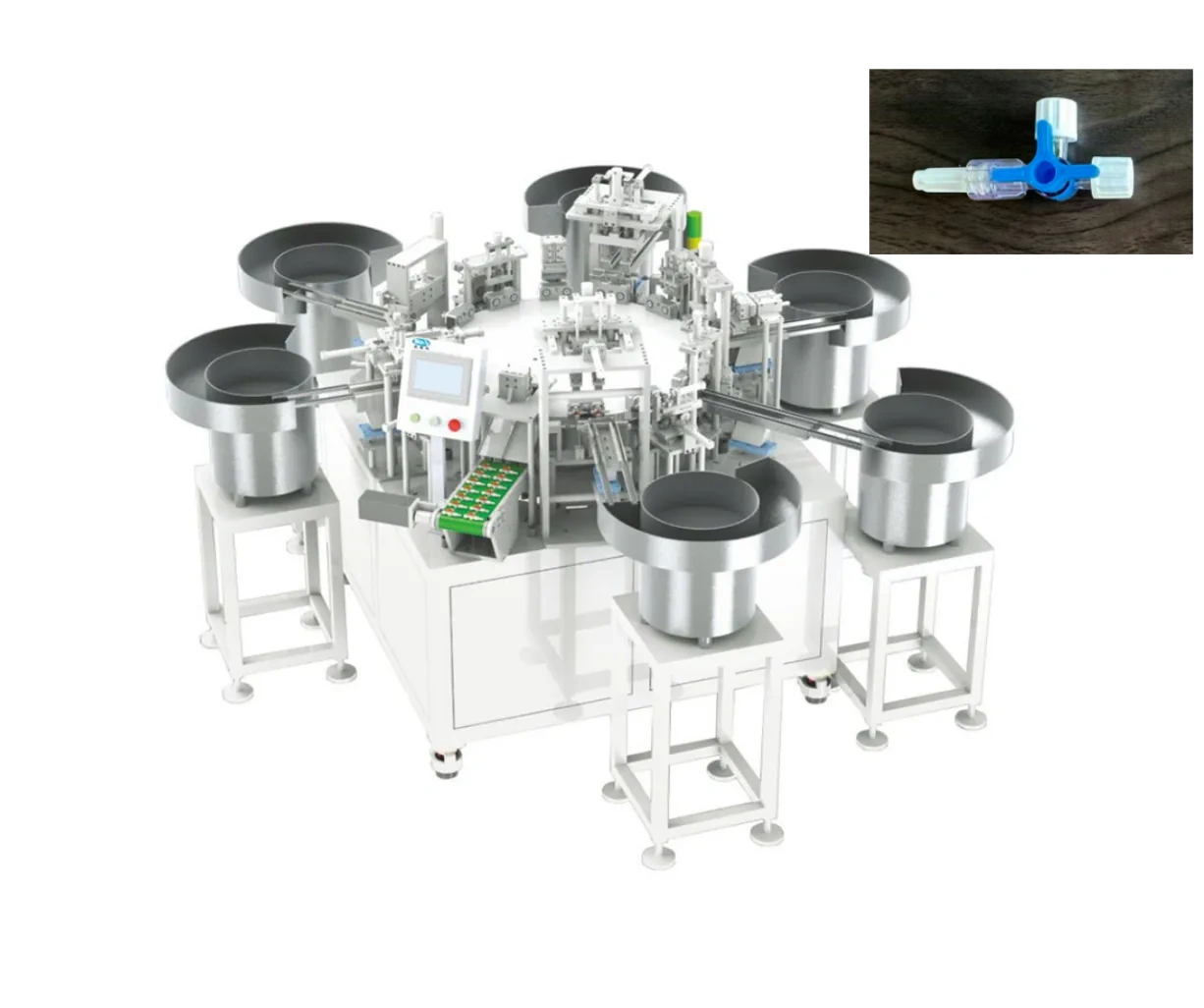
Three-way stopcocks are small but essential components in modern infusion therapy. These valves allow healthcare providers to control and redirect fluid flow between multiple IV lines, enabling simultaneous administration of different medications, IV fluid boluses, and blood draws without repeated needle sticks. Manufacturing these precision devices requires specialized three-way stopcock assembly machines that produce millions of valves annually with consistent quality and performance.
Understanding Three-Way Stopcocks
A three-way stopcock is a rotary valve with three luer connection ports and a rotating tap or handle that controls which ports are open to flow. The body houses a precision-machined plastic core (the plug or rotor) with flow channels that align with different port combinations as the handle rotates. Typical configurations allow flow from Port 1 to Port 2, Port 2 to Port 3, or all three ports connected simultaneously.
The main components include the valve body (housing), the rotary plug with integrated handle, and sealing elements that prevent leakage between flow channels. All components are manufactured to extremely tight tolerances to ensure smooth rotation, zero leakage, and consistent flow characteristics across millions of units.
The Automated Assembly Process
Three-way stopcock assembly machines automate the precise process of assembling these miniature valves. The process begins with component feeding—vibratory bowl feeders sort and orient valve bodies, rotary plugs, and handles. Advanced vision systems verify correct part orientation before assembly begins.
The core assembly operation involves inserting the rotary plug into the valve body with precise axial alignment. This step requires exceptional accuracy because the plug must fit snugly enough to prevent leakage yet rotate smoothly with consistent torque. Some designs incorporate lubricious coatings or use specific material combinations (such as PC body with PE plug) to achieve the optimal balance of seal and rotation feel.
Handle installation follows, with the tap handle precisely indexed to align with the plug’s flow channels. This alignment is critical—the handle position indicators must accurately reflect the actual flow path inside the valve. Additional assembly steps may include installing color-coded caps, luer lock rings, or extension tubing for certain configurations.
Quality Testing and Performance Verification
Every assembled stopcock must pass rigorous functional testing. Pressure decay leak testing verifies that closed ports maintain a complete seal at working pressures (typically tested up to 3 bar or higher). Flow testing confirms that open channels provide unobstructed fluid passage. Torque measurement ensures the handle rotates with appropriate resistance—not too loose to prevent accidental position changes, not too tight to impede clinical operation.
Vision inspection systems verify handle position alignment, check for cosmetic defects, and confirm luer taper dimensions meet ISO 594 standards for compatibility with syringes and other IV devices. Lipid-resistant models undergo additional testing to verify performance with lipid-based parenteral nutrition solutions.
Production Efficiency and Market Impact
High-speed three-way stopcock assembly machines can produce 300 to 600 units per minute with minimal operator intervention. The machines support various configurations—standard luer lock, spin-lock, and tubing-connected versions—and accommodate different handle colors for easy clinical identification.
As IV therapy becomes more complex—with patients receiving multiple medications simultaneously and infusion protocols requiring precise flow management—the demand for reliable three-way stopcocks continues to grow. Automated assembly technology ensures manufacturers can deliver the volume, consistency, and quality that healthcare providers depend on for safe, effective patient care.