Published: Component Focus | Infusion Technology
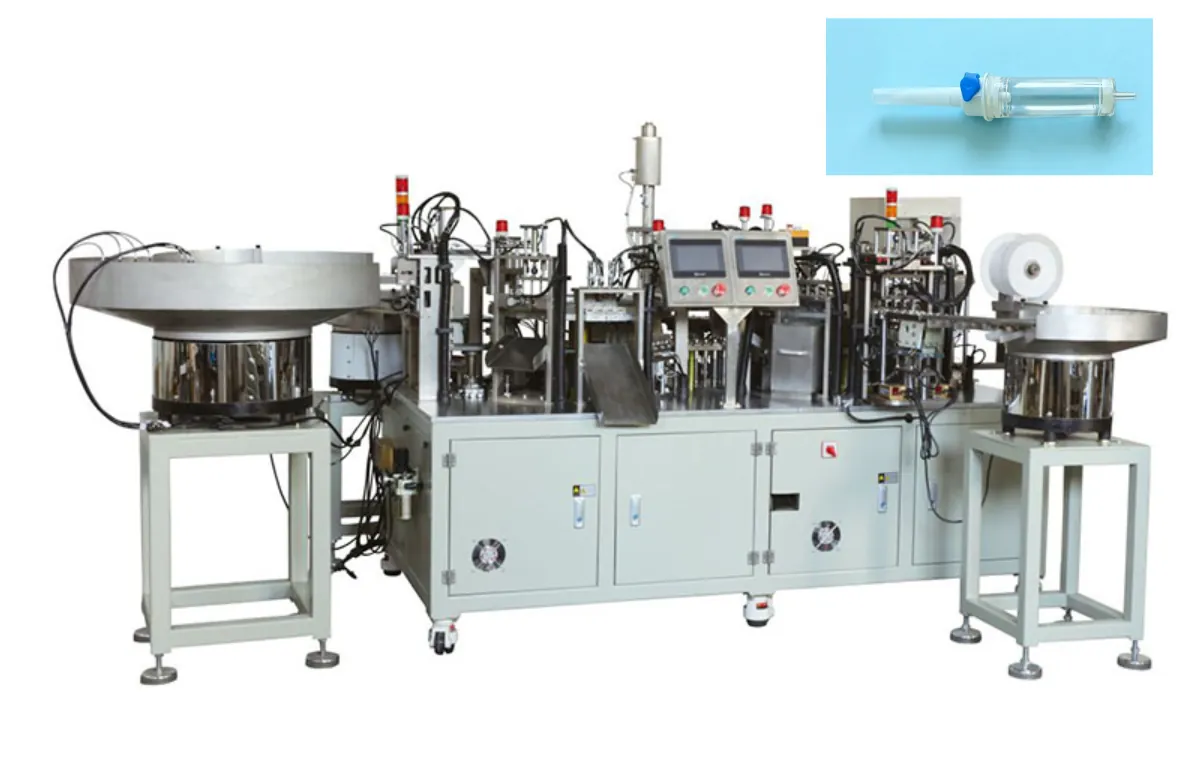
The drip chamber is one of the most critical components of any intravenous infusion set. This small, transparent chamber serves as both a flow visualization tool and a safety barrier, allowing healthcare providers to monitor drip rates while preventing air bubbles from entering the patient’s bloodstream. Producing these precision components requires specialized drip chamber assembly machines that combine multiple sub-components into a single, reliable unit.
Anatomy of a Drip Chamber
A standard drip chamber is more complex than it appears. It typically consists of an upper housing that connects to the spike assembly, a drip orifice that controls drop size (usually calibrated to 20 drops per milliliter for standard sets), a filter membrane that traps particulate matter, and a lower chamber body that connects to the infusion tubing. Some models also incorporate air vents with bacterial filters for vented spike configurations.
The Assembly Process
Drip chamber assembly machines automate the intricate process of combining these various components into a single hermetically sealed unit. The process begins with the feeding and orientation of the upper and lower chamber housings. Precision insertion mechanisms then place the drip orifice and filter membranes at exact positions within the chamber body.
Many drip chambers require adhesive bonding or ultrasonic welding to create permanent seals between components. Advanced machines use automated glue dispensing systems with micro-volume precision, applying medical-grade adhesives in exact quantities. Curing stations—either thermal or UV-based—ensure bonds reach full strength before proceeding to the next assembly stage.
Critical Testing and Verification
Given the safety-critical nature of drip chambers, assembly machines integrate multiple testing stations throughout the production process. Photoelectric sensors verify that each component—filter membranes, drip orifices, air inlet plugs—is properly installed and oriented. Leak testing applies controlled air pressure to confirm the assembled chamber is completely airtight. Flow calibration verification ensures drip rates fall within specified tolerances.
Vision inspection systems examine each finished chamber for cosmetic defects, proper filter placement, and assembly completeness. Any unit failing inspection is automatically rejected, ensuring only flawless components proceed to final infusion set assembly.
Technical Specifications and Capabilities
Modern drip chamber assembly machines are designed for high-volume production, with typical outputs ranging from 5,000 to 6,000 units per hour. They support various chamber sizes and configurations, from pediatric micro-drip chambers (60 drops/ml) to standard adult models. Quick-change tooling and programmable recipe systems allow manufacturers to switch between product variants efficiently.
As infusion therapy becomes more sophisticated—with specialized sets for chemotherapy, pain management, and total parenteral nutrition—the demand for precision-engineered drip chambers will continue to grow. Manufacturers equipped with advanced drip chamber assembly technology are well-positioned to meet these evolving market requirements.